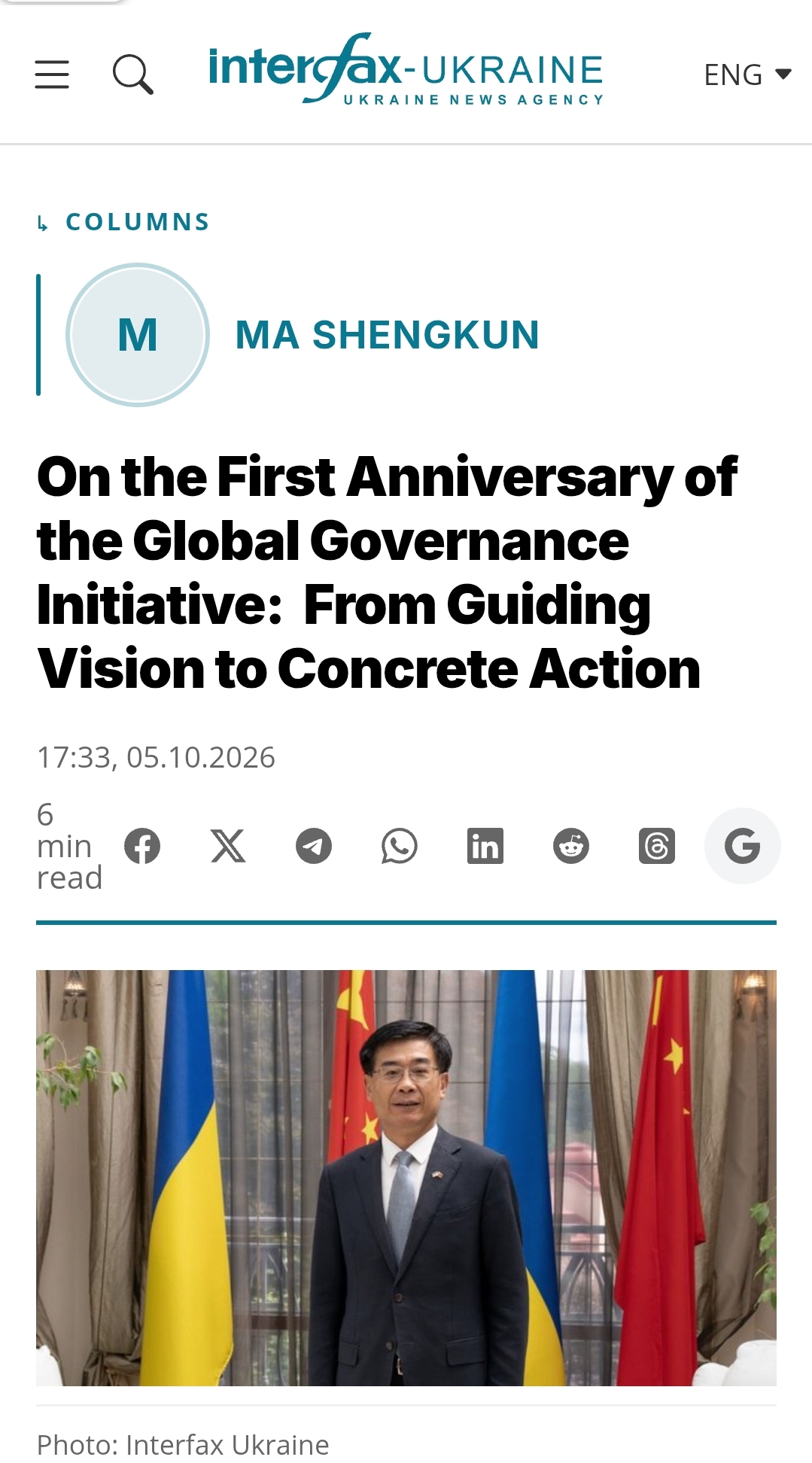
Ambassador of China to Ukraine Ma Shengkun published signed article in Ukrainian media, titled “On the First Anniversary of the Global Governance Initiative: From Guiding Vision to Concrete Action”
On October 5, Ambassador Ma Shengkun published a signed article titled “On the First Anniversary of the Global Governance Initiative: From Guiding Vision to Concrete Action” in Interfax-Ukraine and on the Ukrainian online outlet EconomistUA.
The full text of the article in Ukrainian was published on both media platforms.
On September 1, 2025, President Xi Jinping chaired the “Shanghai Cooperation Organization (SCO) Plus” Meeting in Tianjin and delivered an important speech titled “Pooling the Strength of the Shanghai Cooperation Organization To Improve Global Governance,” in which he formally proposed the Global Governance Initiative (GGI). Over the past year, the Initiative has evolved from a declaration of principles into practical action, received broad and positive responses from the international community and produced increasingly tangible results.
This year the world has continued to face numerous challenges: the deficits in peace, development, security and governance have become increasingly intertwined. Bloc confrontation and the Cold War mentality have resurfaced. Global challenges have continued to emerge. Unilateralism and protectionism are on the rise. The efficacy of multilateral mechanisms is weakening, and the representation and voice of numerous developing countries in global governance remain seriously inadequate. The international community is calling for more open, fair and efficient international governing mechanisms. It is precisely against this backdrop that the Global Governance Initiative was proposed. The Initiative clearly answers the questions of our times, namely what kind of global governance system to build and how to reform and improve global governance. It also provides a “golden key” to tackling both current and future challenges of global governance.
In essence, the Initiative is underpinned by five core concepts. First, staying committed to sovereign equality. All countries, regardless of size, strength or wealth, are equal in international affairs and should participate in, make decisions in and benefit from global governance as equals. Hegemonism and power politics must be opposed. Second, abiding by international rule of law. It is important to uphold the basic norms governing international relations built on the purposes and principles of the U.N. Charter, oppose the selective application of international law and double standards, and reject attempts to put the domestic laws of a few countries above international rules. Third, practicing multilateralism. It is important to uphold the principle of extensive consultation and joint contribution for shared benefit, safeguard the central role of the U.N. in the international system, and resolve differences through dialogue and consultation. Fourth, advocating the people-centered approach. It is important to strengthen practical cooperation in areas such as poverty reduction, public health and education, and ensure that the benefits of development are shared by all countries more equitably. Fifth, focusing on taking real actions. It is important to focus on concrete issues such as climate change, development financing and AI governance, and address real-world challenges through practical cooperation. These five core concepts are in line with the purposes of the U.N. Charter and align with the U.N. 2030 Agenda for Sustainable Development.
Since its launch, the Initiative has received positive responses from the international community. To date, the Initiative has won the support of nearly 160 countries and international organizations. The Group of Friends of Global Governance has been established in New York, Geneva and Vienna, with its membership expanding from 43 founding members to more than 60 countries. As a dedicated platform for dialogue on global governance, it has substantively engaged in the U.N. agenda. The Group delivered a joint statement at the U.N. General Assembly Briefing on the U.N.80 Initiative and sent a representative to the General Discussion of the 79th World Health Assembly. On May 28, 2026, Foreign Minister Wang Yi attended the meeting of the Group of Friends of Global Governance at the United Nations Headquarters in New York, which brought together representatives from more than 60 countries. The meeting issued a joint communiqué, forging consensus on five key points, including upholding the authority of the United Nations, safeguarding international rule of law, strengthening solidarity and cooperation, and improving global governance. It also put forward nine reform directions covering such areas as promoting U.N. reform for greater efficiency, enhancing the authority of the Security Council, development financing and AI governance.
China has never ceased its efforts to put the Global Governance Initiative into practice. China released the Concept Paper on the Global Governance Initiative and the white paper More Just and Equitable Global Governance: China’s Principles, Proposals and Actions, clarifying the Initiative’s framework and priorities. The International Organization for Mediation (IOMed), jointly initiated by 19 countries including China, commenced operations in Hong Kong in October 2025. It is the world’s first intergovernmental legal organization dedicated to resolving international disputes through mediation. In May 2026, it successfully resolved its first international maritime dispute, involving parties from China and Singapore. In the same month, it held its inaugural Global Mediation Summit in Hong Kong, drawing over 400 representatives from 48 countries and regions. The World Data Organization was established in Beijing in March 2026, and the World Artificial Intelligence Cooperation Organization was established in Shanghai on July 16, 2026. These platforms are open to all countries and aim to jointly explore effective governance systems suited to today’s world and capable of addressing various threats and challenges. China has also submitted its 2035 Nationally Determined Contributions to the United Nations, set up the Kunming Biodiversity Fund, and plans to host the Global Governance Forum in the Xiong’an New Area this autumn, where it will work with all parties to develop ideas for reforming and improving global governance.
The first anniversary of the Global Governance Initiative offers an opportunity to look back and, at the same time, marks a new starting point. On September 1, 2026, President Xi Jinping delivered an important speech at the Shanghai Cooperation Organization Plus Meeting in Bishkek, systematically elaborating on the vision of an equal and orderly multipolar world. From the four dimensions - sovereign equality and mutual respect; balance, order and the rule of law; multilateralism and dialogue and consultation; mutual benefit, win-win and inclusiveness - he set out a clear direction for advancing the Global Governance Initiative. On September 12, at the 18th BRICS Summit President Xi Jinping delivered a statement titled “Jointly Shouldering the Responsibility of the Times and Striving to Be a Pioneering Force”, reiterating that the Four Global Initiatives provide a systematic solution to the deficits in development, security, civilization and governance. Centered on sovereign equality, international rule of law, multilateralism, the people-centered approach and a focus on real actions, China’s solution is charting a clear path toward improving global governance.
“When the Great Way prevails, the world is for everyone.” Global challenges call for global response, and global governance requires the participation of all countries. More importantly, proposed visions must be followed by concrete actions. As a responsible major country, China has proposed the Global Governance Initiative and made efforts to put it into practice, with the fundamental aim of addressing the current global governance deficit and tackling pressing issues in global governance. Implementing the Global Governance Initiative and building a more just and equitable global governance system will enable more countries to safeguard their own interests and participate in addressing common challenges on an equal footing. China stands ready to strengthen communication and deepen cooperation with more countries, international organizations and regional mechanisms, and work together to build an open, inclusive, clean and beautiful world of lasting peace, universal security and common prosperity.